
 Electronics & Computer
 Smart Home & Security
 Home Appliances
 Kitchen & Dining
 Power & Charging
 Gaming & Entertainment
 Automotive & Outdoor
 Health & Personal Care
 Office Electronics
 Smart Lighting & Ambient


🤝 AFFILIATE DISCLOSURE: AVERY FINDS MAY EARN A COMMISSION IF YOU PURCHASE THROUGH LINKS IN THIS ARTICLE.
Choosing a virtual private server for a website begins with knowing what the site actually needs. A small WordPress installation and a WooCommerce store running regular product imports can use resources very differently, even when they receive similar traffic. BandwagonHost’s Los Angeles DC9 E-Commerce VPS lineup gives you several ways to size the same hosting environment. This review compares four configurations, from 40 GB to 320 GB of storage, using BandwagonHost’s published catalog and documentation. It also explains what to check if you are moving a store or setting up your first self-managed server.
What Is BandwagonHost Los Angeles DC9?
BandwagonHost offers self-managed virtual private servers using KVM virtualization. Its order page identifies the Los Angeles DC9 location as USCA_9 at CoreSite LA2. The provider highlights AMD hardware and NVMe storage at this location, along with network connectivity that includes China Telecom CN2 GIA, China Mobile CMIN2, and China Unicom Premium. If you have customers in several regions, those published network details are a starting point for evaluating the location. Actual performance depends on the route visitors take, the applications running on the VPS, and how the site is configured.
BandwagonHost provides the virtual server and its KiwiVM control panel. You select an available operating system after activation and manage the software on the VPS. For a WooCommerce store, this includes WordPress, the database, server updates, and backups. All four graphics and buttons below open the same Los Angeles DC9 order page. Choose the configuration and billing period there.
1. BandwagonHost DC9 40 GB VPS
The 40 GB configuration lists 2 GB of RAM, 3 vCPUs, 2,000 GB of monthly transfer, and a 2.5 Gbps port. It is the smallest of the four configurations covered here. It makes sense to compare for a development site, a lean blog, or a small application whose memory and storage needs you already understand.
If you plan to run WordPress and its database on the same VPS, count the memory used by both. Scheduled jobs can matter as much as everyday browsing. An image processing task or a product import might run while visitors are already using the site. For storage, leave space for the operating system, database, logs, and software updates alongside the files you upload. If you are moving an existing site, check its current disk usage and memory peaks. That gives you a more practical basis for deciding whether the smallest plan is enough.
2. BandwagonHost DC9 80 GB VPS
The 80 GB VPS lists 4 GB of RAM, 4 vCPUs, 3,000 GB of monthly transfer, and a 2.5 Gbps port. It doubles both storage and RAM compared with the 40 GB option. That extra capacity is worth considering when your setup includes a database, a growing media library, or regular background jobs on the same server.
For WooCommerce, look beyond how quickly a cached product page loads. Checkout, account pages, search, and administrative work can require more processing. If possible, review your current host’s usage charts while a product import runs or during a busy shopping period. Check whether the extra memory addresses the workload you expect. If media files account for most of your storage, consider how much of that library will move to the VPS and how quickly it is growing. The right comparison begins with how you run the store today.
3. BandwagonHost DC9 160 GB VPS
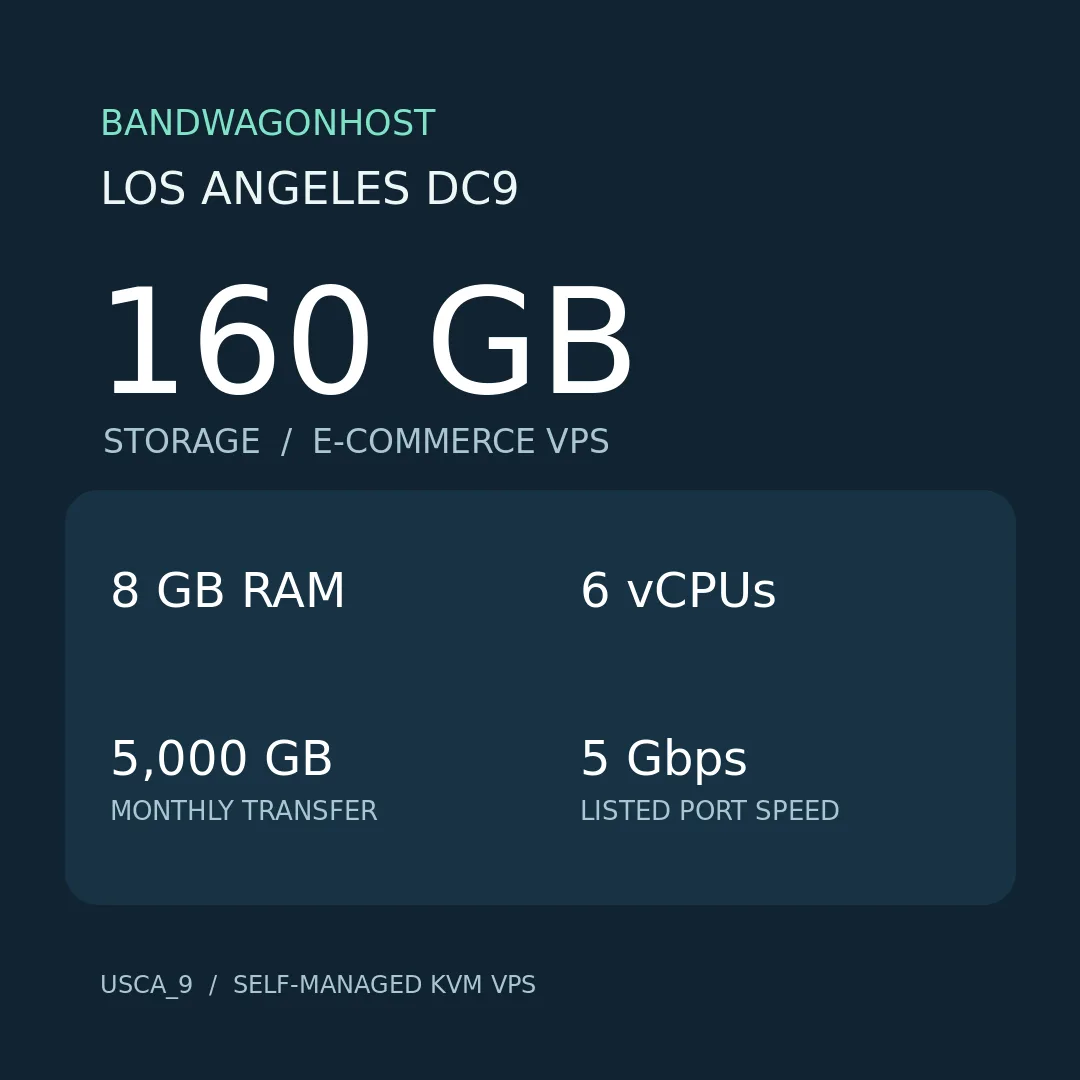
The 160 GB VPS lists 8 GB of RAM, 6 vCPUs, 5,000 GB of monthly transfer, and a 5 Gbps port. This configuration is worth comparing if your website, database, and background workers need more room to run together. It may also fit a setup that keeps a staging copy alongside a primary site, provided you have measured the combined workload.
If you are upgrading because a site has slowed down, use the existing server’s data to identify the constraint. Sustained memory pressure gives you a concrete reason to compare a larger allocation. Slow database queries or delays from an external service call for different work during a migration. For a live store, test a copy before switching DNS. Include the cart, payment flow, transactional emails, and scheduled tasks in that test so you can assess the new setup beyond the homepage.
4. BandwagonHost DC9 320 GB VPS
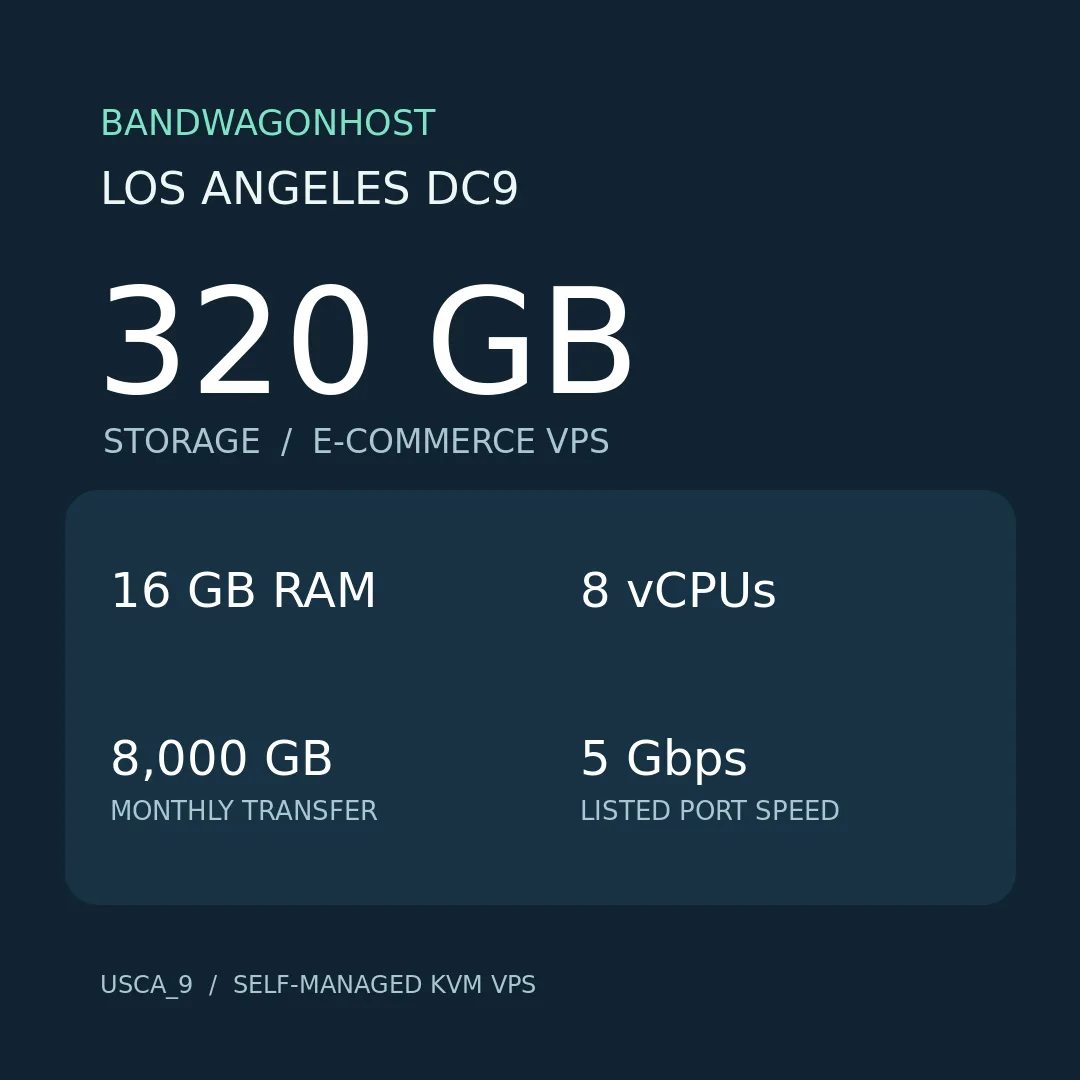
The 320 GB configuration lists 16 GB of RAM, 8 vCPUs, 8,000 GB of monthly transfer, and a 5 Gbps port. It has the most storage and memory of the four plans covered in this review. Consider it if your site has a substantial local media library or if you have several applications with measurable resource needs. A realistic estimate of storage growth helps you judge when the extra capacity will be useful.
Putting several projects on one VPS can simplify the number of servers you administer. It also means that a restart or configuration error can affect multiple projects. Decide how you would restore each site and its database, and keep backups somewhere you can access independently of the VPS. If you are moving a store, think about how often its orders, stock records, and customer activity change when setting the backup schedule.
What to Check Before Ordering
- Tier and location. Confirm that you have selected E-Commerce VPS and Los Angeles USCA_9. Check both fields if you navigate through other options on the order page.
- Billing period. Compare the amount due for the full period shown at checkout. Check which billing options are available for the configuration you choose.
- Storage and memory. Use measurements from your current site where available. Allow room for the database, uploads, logs, and temporary files.
- Monthly transfer. Compare the allowance with your expected traffic. The listed port speed describes the network interface and serves a different purpose from the monthly usage allowance.
- Server administration. Decide who will handle setup, updates, monitoring, and restores after the VPS is activated.
Frequently Asked Questions
Does the E-Commerce VPS come with WordPress or WooCommerce installed?
BandwagonHost uses E-Commerce VPS as the name of a hosting tier. The VPS is self-managed, so you or your administrator will handle the WordPress installation, WooCommerce setup, and ongoing updates.
What is KiwiVM used for?
KiwiVM is BandwagonHost’s control panel for tasks such as selecting an operating system, starting or stopping the VPS, opening an emergency console, checking usage, and taking snapshots. Keep independent backups of site files and databases as part of your own maintenance routine.
Does a 5 Gbps port guarantee faster checkout?
Checkout speed also depends on database queries, plugins, payment requests, and the customer’s connection. Use real page and checkout measurements to evaluate a deployment.
Conclusion
BandwagonHost Los Angeles DC9 is worth comparing if you want a self-managed Linux VPS at this location and can maintain the software yourself. Start with 40 GB or 80 GB for a lean setup whose needs you can measure. Consider 160 GB or 320 GB when your current memory, storage, or transfer usage justifies it. Use the exact USCA_9 order page to confirm availability and the current billing total before choosing.



Reviews
There are no reviews yet.